

Steps For Civil, Constructions and Environmental Engineering (SCCEE)
ISSN: 3005-8198(online) | 3005-818X(print)
Volume 4, Issue 1 (January - March 2026)
 Research Article
Eco-Sustainable and Seismic-Resistant Plasters Incorporating End-of-Life Tire Waste: Experimental Investigation and Numerical Application to a School Building
Department of Structures for Engineering and Architecture (DiSt), University of Naples “Federico II”, Naples, Italy.
Abstract
The construction sector exerts a substantial influence on humanity’s ecological footprint, underscoring the imperative to adopt circular economy principles in building practices and materials to mitigate environmental degradation. The circular economy is a system that aims to optimize resource use and minimize waste by repurposing waste materials and reducing the amount of residual waste. In the field of construction, there is an increasing prevalence of the use of recycled materials, including rubber, plastic, aggregates, wood, and rock wool, in the fabrication of novel, sustainable products. The present study focuses on the utilization of recycled rubber from tires as an aggregate in sustainable mortars for reinforcing existing masonry structures. The research commences with an analysis of sustainable development challenges, followed by a review and comparison of studies that incorporate rubber granules and steel fibers into mortar mixes. The study’s workflow is delineated into three primary phases. In the initial phase, experimental work is conducted by preparing control specimens devoid of rubber, specimens with varying amounts of rubber, and specimens that incorporate steel fibers into rubber-enhanced mortar. These samples are subsequently subjected to rigorous laboratory testing to assess their physical and mechanical parameters. These parameters include, but are not limited to, density, flexural and compressive strength, and surface hardness. The subsequent phase involves the analysis of these results to ascertain the optimal sustainable mortar mix design. In the third phase, findings are applied in practice: a mortar incorporating steel fibers and granulated rubber recovered from discarded tires is employed for the structural strengthening of the “G. Mazza” school in Torre del Greco, Naples, with the aim of enhancing seismic resilience.
Keywords: Recycled Tire Rubber; Steel-Fiber-Reinforced Mortar; Masonry Retrofitting; Seismic Strengthening; Circular Economy; Sustainable Construction.
Introduction
The construction industry is a colossal presence on the global industrial landscape, yet it concurrently stands as a significant contributor to humanity’s ecological footprint. The extraction of raw materials (e.g., sand, gravel, crushed rock), the energy and carbon costs of cement production, and the generation of construction and demolition waste all contribute substantially to environmental degradation. In this context, sustainable building practices and alternative materials are increasingly regarded as strategic methods to mitigate environmental impact. A particularly salient model is the circular economy, which prioritizes the continued utilization of materials, the extraction of optimal value from them, and the recovery and regeneration of products and materials at the conclusion of their service life. The circular economy is predicated on the transformation of waste into resources, thereby offering a systemic approach to reducing both raw-material consumption and waste generation (Prieto-Sandoval et al., 2017; Zvirgzdins et al., 2019). Conventional construction methodologies have predominantly adhered to a linear paradigm, characterized by the sequential processes of extraction, manufacturing, construction, demolition, and final disposal in landfills. This model is becoming increasingly unsustainable in light of the finite nature of natural resources and the increasingly stringent environmental regulations. In the domain of construction, this predicament gives rise to a multitude of challenges, including the mitigation of extraction of virgin aggregates and minerals, the reduction of embodied carbon in cementitious materials, the conceptualization of structures and materials intended for disassembly, reuse, and recycling, and the incorporation of waste streams as secondary raw materials. The circular-economy vision is especially relevant when applied to construction materials, since the potential leverage is high both in material volume and environmental impact (Buruzs & Kozma, 2023; Papamichael et al., 2023; Purchase et al., 2021).
Among the various types of waste materials that have been investigated for their potential as construction materials, end-of-life tires (along with the rubber, steel cord, and polymer fibers they contain) have demonstrated particular promise. On the one hand, tires constitute an expanding environmental liability due to their recalcitrance in the face of biodegradation, their capacity to occupy landfill space, their potential to ignite fires, and their representation of a wasted resource. Conversely, tire-derived components are available in substantial quantities and possess physical, mechanical, and durability characteristics that can be leveraged in cementitious composites. Indeed, studies have indicated that over 500,000 tons of high-quality steel fibers could be recovered annually from used tires in the EU, underscoring both the opportunity and the scale of this endeavor (Pilakoutas et al., 2004).
Preliminary studies demonstrate that the incorporation of recycled rubber as an aggregate in construction enhances material flexibility and impact resistance, though it may concomitantly result in a slight reduction in compressive and flexural strengths (Bravo & de Brito, 2012). Research on rubberized mortars indicates that rubber granules improve ductility and energy dissipation, making them well-suited for reinforcement purposes (Youssf, ElGawady, et al., 2016; Youssf, Mills, et al., 2016). The addition of 0.5–1% rubber by volume to concrete has been demonstrated to enhance the ductility of reinforced concrete columns, thereby increasing their resilience under seismic loads (Son et al., 2011). Moreover, the incorporation of recycled rubber as a substitute for aggregate has been shown to enhance the durability of the material (Bušić et al., 2018). Conversely, the incorporation of varying rubber contents within concrete has been observed to diminish mechanical performance, evidenced by a decline in tensile and flexural strengths by approximately 13% and 21%, respectively, and a substantial reduction in modulus of elasticity by about 24% at moderate rubber contents. It has been demonstrated that the presence of rubber in excess of 5% invariably results in a deterioration of the mixture’s integrity. Conversely, the addition of rubber has been shown to enhance ductility by up to 86% when the content reaches 12%. Consequently, the majority of studies advocate for the restriction of rubber content to 0–5% as fiber or 0–10% as aggregate replacement, with the objective of preserving acceptable strength while concurrently enhancing ductility (Kilani et al., 2024). The incorporation of waste rubber into concrete and cement mortar has been shown to offer several advantages, including reduced weight and enhanced thermal insulation. However, the optimal balance between these benefits and the potential reduction in mechanical performance, contingent on the specific application, remains a subject of ongoing research (Marinelli et al., 2023).
Concurrently, the steel fibers that persist in tires, particularly the steel cord or bead, constitute an additional underutilized resource in the circular economy for construction. A multitude of studies have demonstrated that steel fibers, derived from waste tires, can offer substantial enhancements in tensile strength, fracture resistance, crack bridging, impact resistance, and post-cracking behavior when incorporated into concrete or mortar. Consequently, the incorporation of recycled steel fibers has been demonstrated to counterbalance the conventional compressive strength reductions that are concomitant with rubber inclusion (see Aiello et al., 2009; Awolusi et al., 2019; Centonze et al., 2012). Indeed, a study by Zia et al. (2022) revealed that incorporating recycled steel fibers into mortars can yield substantial enhancements in various mechanical properties. The study reported up to a 46% increase in compressive strength, a 50.6% increase in split tensile strength, and a notable 69% increase in flexural strength, when compared to traditional mortars. Research has demonstrated that recycled tire steel fibers exhibit superior adhesion to the cement matrix in comparison to conventional industrial steel fibers, indicating a significant potential for structural applications (Michalik et al., 2023).
Consequently, the dual usage of rubber for aggregate replacement and recycled steel fibers offers a method to develop composite mortars with enhanced structural resilience, while concurrently delivering sustainability benefits via the circular economy (Abdolpour et al., 2022; Tang et al., 2021).
In this framework, the present study investigates the potential of recycled rubber from tires as an aggregate in mortars for reinforcing existing masonry structures. The objective of the research is to develop a composite mortar mix that aligns with sustainability goals while enhancing structural resilience by combining rubber and steel fibers. The practical effectiveness of this research was demonstrated through the structural retrofitting of a masonry school building located in Southern Italy.
Materials and Methods
The research was methodically executed in three phases to develop and evaluate an eco-sustainable mortar for structural reinforcement by incorporating recycled rubber tires and steel fibers. The initial two phases encompassed the experimental campaign and the selection of an optimal mix design, which was subsequently implemented on a real-world masonry structure in phase three. The subsequent section delineates the fundamental material properties and testing methodologies employed in the experimental investigation.
Materials Properties
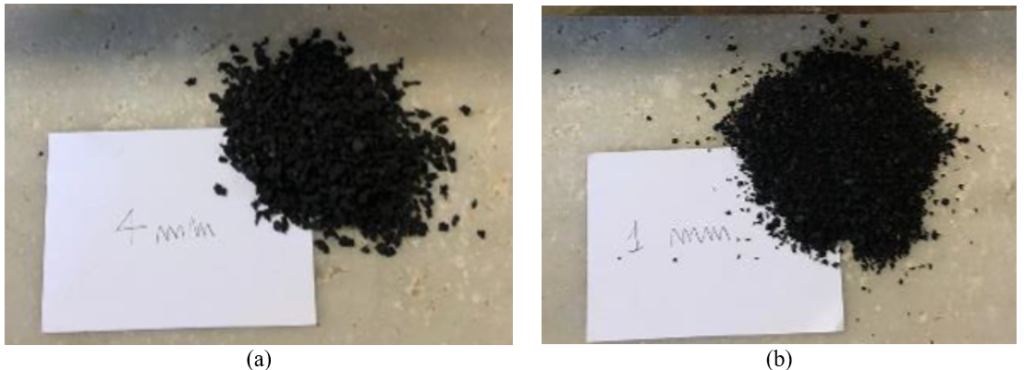
The eco-sustainable mortar was designed by incorporating granulated rubber and steel fibers in a traditional cementitious mortar. The traditional mortar is composed of Portland cement, sand, and water. The primary materials utilized in the construction of the concrete mixture are a cement classified as CEM II/B-L 32.5 N according to the EN/197-1 standard and river sand. The utilization of these additives, derived from decommissioned tires, facilitates the transition towards a circular economy model while concomitantly reducing the environmental impact of the intervention. The rubber was subjected to a process of mechanical granulation, resulting in the formation of crumb-like particles. This procedure was implemented to ensure the uniformity of its physical properties. Among the produced batches, only the granules having 1 mm and 4 mm diameter were selected for further analysis (Figure 1).
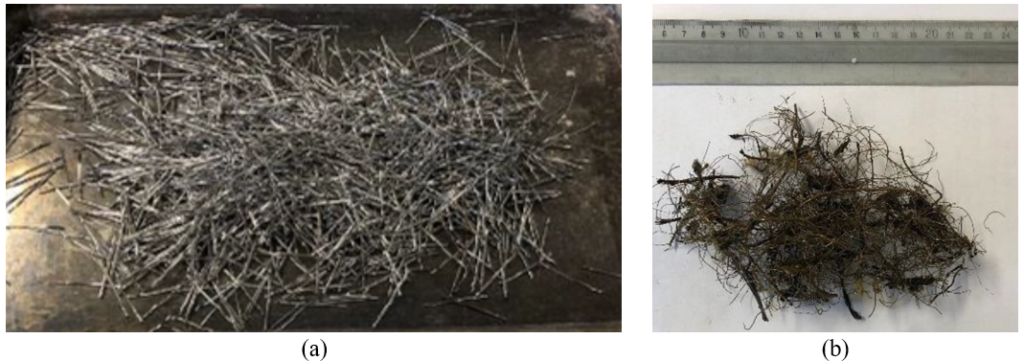
Two types of steel fibers were utilized in the study: The first type of steel fiber is produced via cold-drawing, and its ends are deformed with the specific design to improve the mechanical bond with the cement paste. The second type of steel fiber is derived from recycled materials, specifically from the metallic components of end-of-life tires, such as steel belts and cords encapsulated inside the tire structure. The recycling process entailed the extraction, cleaning, and cutting of these steel fibers to ensure a longitudinal dimension that closely approximates that of the standard commercial fibers. To ensure consistency, recycled steel fibers with lengths of approximately 20 mm were selected, equivalent to the lengths of the commercial fibers (Figure 2).
Mix Design
A total of twelve distinct mortar mixes were formulated by varying the incorporation of rubber particles and steel fibers. Furthermore, an unmodified mortar was prepared to serve as a baseline for comparison, allowing the evaluation of how these inclusions influence both mechanical performance and physical characteristics. Rubber crumbs were utilized as a volumetric substitute for fine aggregate at replacement ratios of 5% and 10%. The incorporation of steel fibers was executed at a constant fraction of 0.5% relative to the total mix volume. The proportion of sand to cement was maintained constant for all mixtures, with the only variation being the partial substitution of sand with rubber. Consequently, the proportion of water to cement remained constant across all formulations.
To ensure adequate consistency, the water-to-cement ratio of the reference mortar was increased from the conventional value of 0.5 to 0.7. Accordingly, the control mixture consisted of 315 g of water, 450 g of cement, and 1,350 g of sand. A thorough delineation of the mix identification and constituent materials is furnished in Table 1. In the subsequent sections of this study, the baseline mixture that does not contain rubber particles or fiber reinforcement is referred to as “CNTL.”
The investigated mixtures are designated using a nomenclature that indicates the additional components relative to the control mix, followed by the percentage of rubber content. Specifically, the code R4 denotes rubber granules with a mean diameter of 4 millimeters, while R1 indicates rubber granules with a mean diameter of 1 millimeter. The code “CF” is used to denote commercial steel fibers, while “RF” indicates the use of recycled steel fibers.
Table 1. Mix Design of Tested Specimens.
| Mixture Code | Rubber Particle Size (mm) | Rubber Replacement Ratio (% vol.) | Fiber Type | Fiber Volume Fraction (%) |
|---|---|---|---|---|
| CNTL | — | — | — | — |
| R4_5% | 4 mm | 5% | — | — |
| R4_10% | 4 mm | 10% | — | — |
| R1_5% | 1 mm | 5% | — | — |
| R1_10% | 1 mm | 10% | — | — |
| CF+R4_5% | 4 mm | 5% | Commercial | 0.5% |
| CF+R4_10% | 4 mm | 10% | Commercial | 0.5% |
| CF+R1_5% | 1 mm | 5% | Commercial | 0.5% |
| CF+R1_10% | 1 mm | 10% | Commercial | 0.5% |
| RF+R4_5% | 4 mm | 5% | Recycled | 0.5% |
| RF+R4_10% | 4 mm | 10% | Recycled | 0.5% |
| RF+R1_5% | 1 mm | 5% | Recycled | 0.5% |
| RF+R1_10% | 1 mm | 10% | Recycled | 0.5% |
Physical Characterization
The physical characterization of the mortar was conducted to evaluate the bulk density of the fresh mortar. The method employed in this study was guided by the principles outlined in the UNI-EN 1015-6:1999 standard (EN 1015-6, 1999). For the test, a 361 ml container was weighed in a state of emptiness, dryness, and cleanliness to ascertain its mass, designated as M1. The container was subsequently filled with mortar in two stages involving manual consolidation followed by levelling. The full container was weighed to determine the mass, M2. The bulk density was determined by calculating the ratio between the mortar weight (M2 – M1) and the container volume (Vv).
Mechanical Characterization
Specimens’ Manufacturing
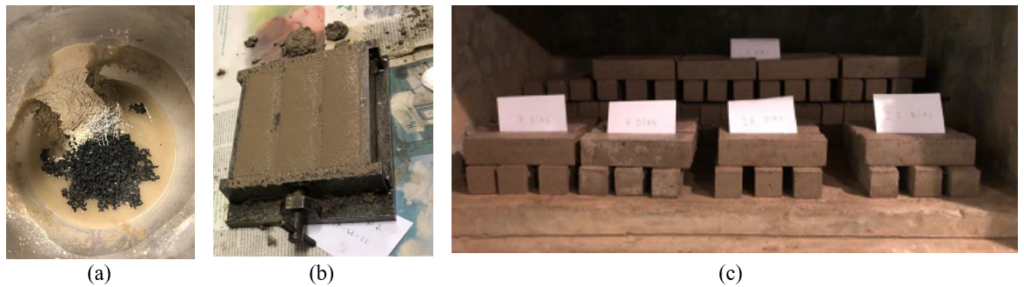
The mechanical investigation was conducted on three specimens, with dimensions of 40 x 40 x 160 mm, for each mix design. The mixtures were prepared in accordance with the procedure delineated in the EN 196-1:2019 standard (EN 196-1, 2019) employing a planetary mixer. During specimen preparation, the mold was filled in two stages, with each layer being compacted and levelled.
Subsequently, the specimens were stored within a humid chamber maintained at a temperature of 20°C and a relative humidity of 95% until the mechanical tests were conducted. As illustrated in Figure 3, the specimen manufacturing process is comprised of several distinct phases.
Shore Hardness Test
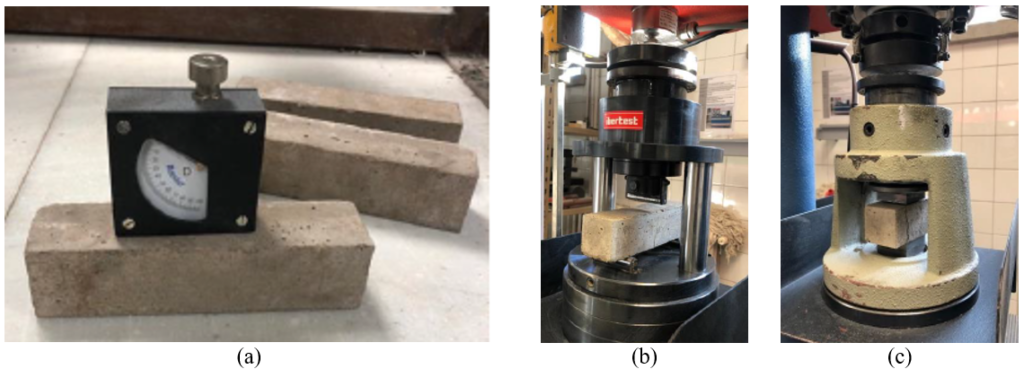
The initial mechanical evaluation of the specimens involved the assessment of surface hardness following a curing period of 7 and 28 days, prior to the execution of the bending and compression tests, respectively. The test was conducted on two longitudinal faces of the samples using a Shore durometer, applying a perpendicular force at five points on each face. Subsequently, the surface hardness was evaluated by calculating the arithmetic mean of the measured values.
Bending and Compression Test
Subsequently, bending and compression tests were conducted on the prismatic specimens after 7 and 28 days of curing. The initial evaluation was conducted using a three-point bending test on 40 x 40 x 160 mm specimens. Subsequent to the occurrence of bending failure in the mortar, the two halves of the specimens were utilized for the compressive strength test, which was conducted using a 40 x 40 mm loading plate. The execution of these mechanical tests is depicted in Figure 4.
Results of the Experimental Investigation
Bulk Density
The outcomes of the physical characterization demonstrated that the bulk density in the fresh state of the traditional cementitious mortar was significantly greater than that of the mortar mixtures incorporating rubber and steel fibers (Figure 5).
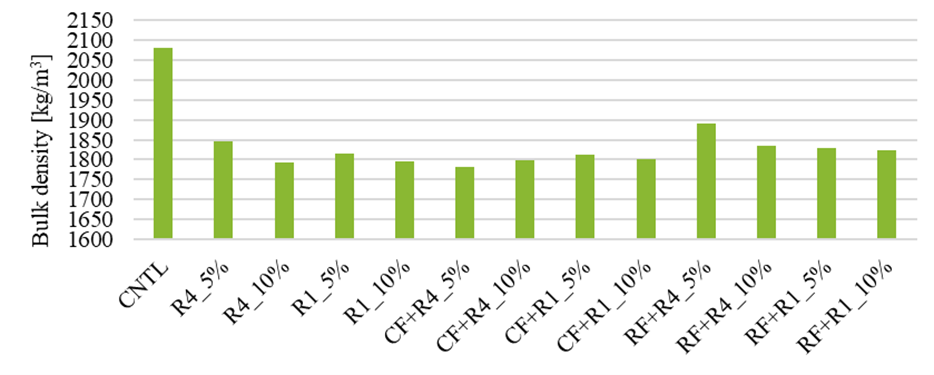
Specifically, the bulk density of the traditional mortar was approximately 2081 kg/m³, while the incorporation of rubber and steel fibers resulted in bulk density values ranging from 1891 kg/m³ to 1781 kg/m³, corresponding to a decrease of 9% to 14% compared to the traditional mortar. Additionally, it was observed that commercial steel fibers result in a slightly higher reduction in bulk density than recycled fibers. This phenomenon is possibly attributable to the different shapes and distribution in the mixture.
Shore Hardness Test
The substitution of 5% of the sand with rubber granules of 4 mm and 1 mm led to a substantial enhancement in surface hardness of the samples, as evidenced by the hardness test results at the conclusion of both the 7-day and 28-day periods. In a similar manner, mortars incorporating commercial steel fibers demonstrated an increase in surface hardness at the identical 5% replacement level. However, the incorporation of recycled steel fibers enhanced the surface hardness of the reference mixture only in the mixture containing 4 mm rubber granules at 5% replacement, as illustrated in Figure 6.
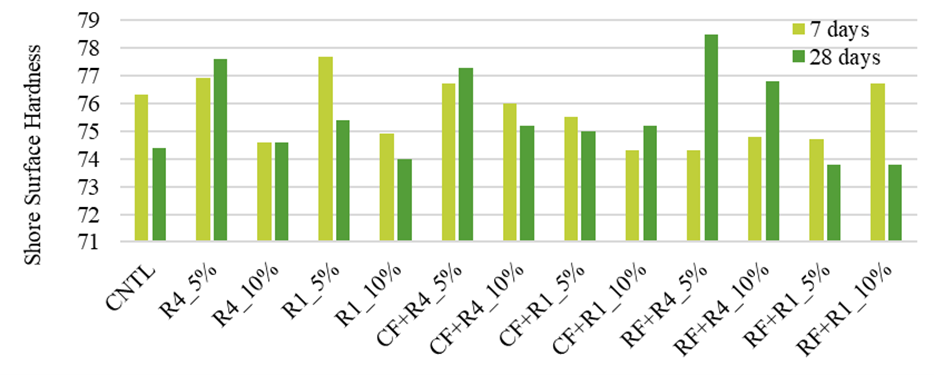
In the seventh day, the surface hardness exhibited both the maximum and minimum values for mortars incorporating rubber granules measuring 1 mm. The maximum values were observed in the mixture with a 5% replacement level, while the minimum values were identified in the mixture with a 10% replacement level and 0.5% commercial fibers.
At the 28-day curing stage, the mortar mixture incorporating 4 mm rubber particles at a 5% replacement level combined with 0.5% recycled fibers exhibited the greatest surface hardness. Conversely, the lowest hardness values were recorded for the mixture containing 1 mm rubber particles at an identical replacement ratio (5%) in conjunction with 0.5% recycled fibers.
Bending Test
The bending test was performed on three specimens per mixture, with each specimen measuring 40 x 40 x 160 mm. The flexural strength results, which represent average values for curing times of 7 and 28 days, are displayed in Figure 7.
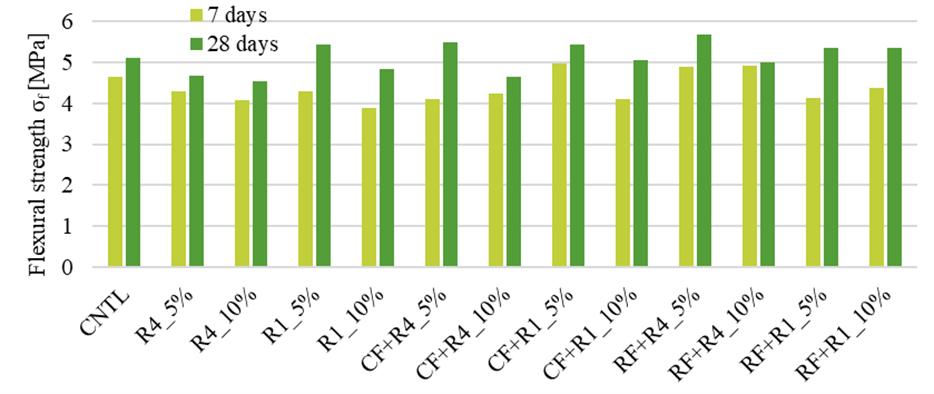
Following a seven-day curing period, the mixtures incorporating 10% rubber granules exhibited the most significant reductions in flexural strength. In contrast, the incorporation of 5% 1 mm rubber granules, in conjunction with commercial steel fibers, has been shown to yield a 2.5% increase in flexural strength when compared to the reference mix.
Following a 28-day curing period, composites comprising 1 mm and 4 mm rubber particles, in conjunction with commercial steel fibers, demonstrated a decline in flexural strength when compared to the control specimen. Conversely, the formulation comprising 4 mm rubber particles, in conjunction with 5% recycled fibers, exhibited augmented flexural performance, exhibiting an increase of 11.4% in comparison to the reference mix.
These variations can be attributed to the combined effects of rubber inclusions, fiber reinforcement, and the surrounding cementitious matrix. The presence of rubber particles has been shown to disrupt the homogeneity of the matrix, resulting in a reduction in load-bearing capacity, particularly during the initial stages of curing. While steel fibers can initially mitigate this effect by bridging microcracks, their effectiveness diminishes over time. As the matrix undergoes further development, the weak interfacial bond and deformability of rubber particles become more influential, resulting in strength deterioration. Conversely, recycled fibers, distinguished by their rougher surface textures, have been shown to enhance mechanical interlocking and bonding with the matrix. Furthermore, the presence of larger rubber particles has been demonstrated to enhance stress redistribution, thereby explaining the observed increase in strength observed at later ages.
With regard to ductility, the incorporation of rubber granules did not yield substantial impact on the outcomes. The enhancement of ductility was primarily attributable to the incorporation of steel fibers, a consequence of the sewing effect. The control mortar and the mix designs containing exclusively rubber granules exhibited a brittle failure under flexion. However, the incorporation of both commercial and recycled steel fibers enhanced the mortar’s ductile behavior, resulting in an average increase of 7% in peak strain and 45% in ultimate strain compared to the control mix.
Compression Test
The compression test was performed on three specimens per mixture, with each specimen measuring 40 x 40 x 40 mm. The mean compressive strength values for curing times of 7 and 28 days are illustrated in Figure 8.
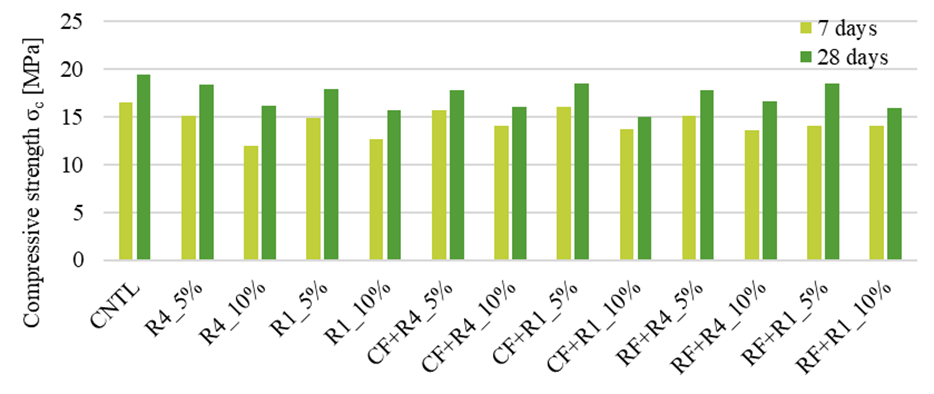
The findings demonstrated a progressive decline in compressive strength with increasing rubber content, particularly in blends comprising larger rubber granules. In the seventh day, the incorporation of a 10% rubber content resulted in a 27% decrease in compressive strength for the 4 mm rubber granules and a 23% decrease for the 1 mm rubber granules, as compared to the reference mortar. A smaller reduction in compressive strength was observed with 5% rubber and commercial steel fibers, specifically 5% for the 4 mm rubber and 3% for the 1 mm rubber.
These trends remained consistent following a 28-day curing period, with a progressive decline in compressive strength observed as the rubber content increased. Notably, for the mixture containing 5% granules of both sizes, a similar reduction in compressive strength was observed at 28 days, irrespective of the type of steel fibers utilized, whether they were commercial or recycled (8% for the 4 mm granules and 5% for the 1 mm granules). The decline in compressive strength with an increase in rubber content can be attributed to the inherent low stiffness of rubber and its suboptimal bonding properties, resulting in disruption to the matrix. The presence of larger granules has been demonstrated to result in the formation of weaker zones, thereby amplifying the observed effect. In the seventh day, the implementation of steel fibers serves to mitigate the reduction in strength that would otherwise occur by acting as a bridge over the cracks. After 28 days, the stronger matrix highlights the limitations of rubber, while the fiber type exerts minimal influence, as both primarily control cracking rather than enhance compressive strength.
With regard to ductility, the incorporation of rubber granules did not yield substantial impact on the outcomes. The primary contribution to the enhancement of ductility was attributable to the incorporation of steel fibers, a phenomenon that can be attributed to the confinement effect. The control mortar and the mix designs containing exclusively rubber granules exhibited a brittle failure under compression. However, the incorporation of both commercial and recycled steel fibers enhanced the mortar’s ductile behavior, resulting in an average increase of 5% in peak strain and 70% in ultimate strain compared to the control mix.
Selection of the Most Efficient Mix Design
The experimental investigation yielded optimal outcomes, with the highest-performing mortar comprising rubber granules measuring 4 mm, at a 5% ratio, in conjunction with 0.5% recycled fibers. This blend exhibited the most significant enhancement in flexural strength (+11%) and a substantial reduction in compressive strength (−8%). Consequently, this formulation was selected as an eco-sustainable and earthquake-resistant plaster for application in a case study building.
Case Study: the School Building “G. Mazza”
Description of the Building
The final stage of the research concentrated on the practical implementation of the selected mortar mixture at the “G. Mazza” school building, located in Torre del Greco, a district of Naples. The edifice, which accommodates a primary educational institution, is located in a densely populated area in proximity to the port. The property’s total footprint encompasses approximately 1,200 square meters, encompassing two structures constructed between 1919 and 1945 (Figure 9).
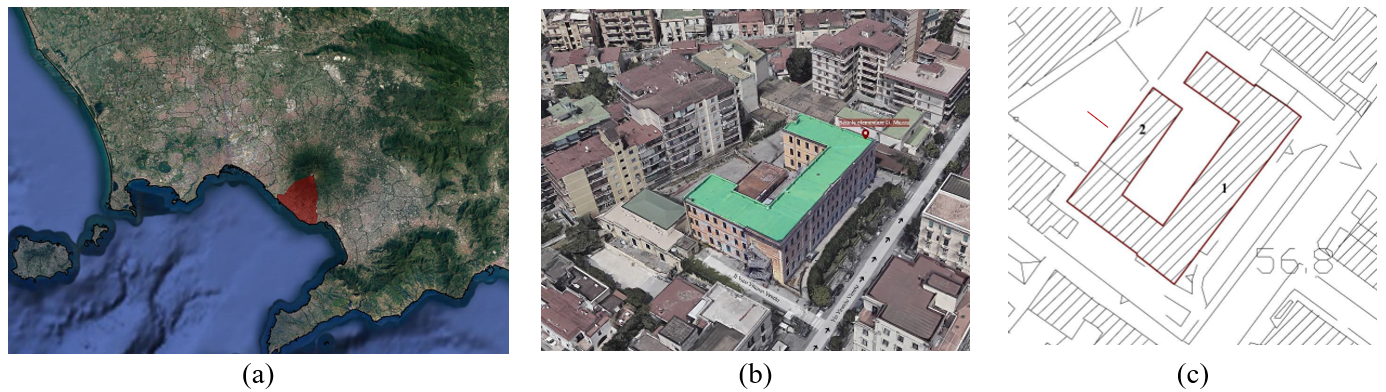
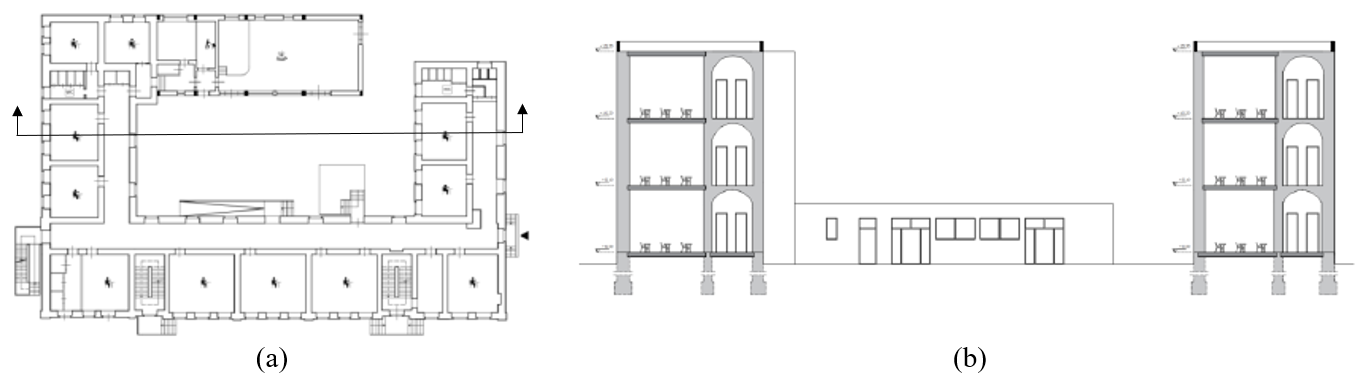
Building 1 is distributed over three levels and is composed of load-bearing masonry walls constructed from tuff blocks. It possesses an irregular floor plan. The floors are supported by steel beams and hollow tiles, while the corridors are vaulted with tuff cross-vaults. Conversely, Building 2 is a single-level structure featuring a reinforced concrete (RC) frame and a solid RC slab roof (Formisano et al., 2024). As illustrated in Figure 10, the initial floor plan is presented, accompanied by a vertical section of the entire school building.
Numerical Model and Seismic Analysis
To quantify the benefits of the selected eco-sustainable mortar, a numerical simulation of the structure was implemented both before and after reinforcement using 3Muri software by S.T.A. DATA company. In these models, the load-bearing walls were represented as an equivalent frame. The resulting model is illustrated in Figure 11.
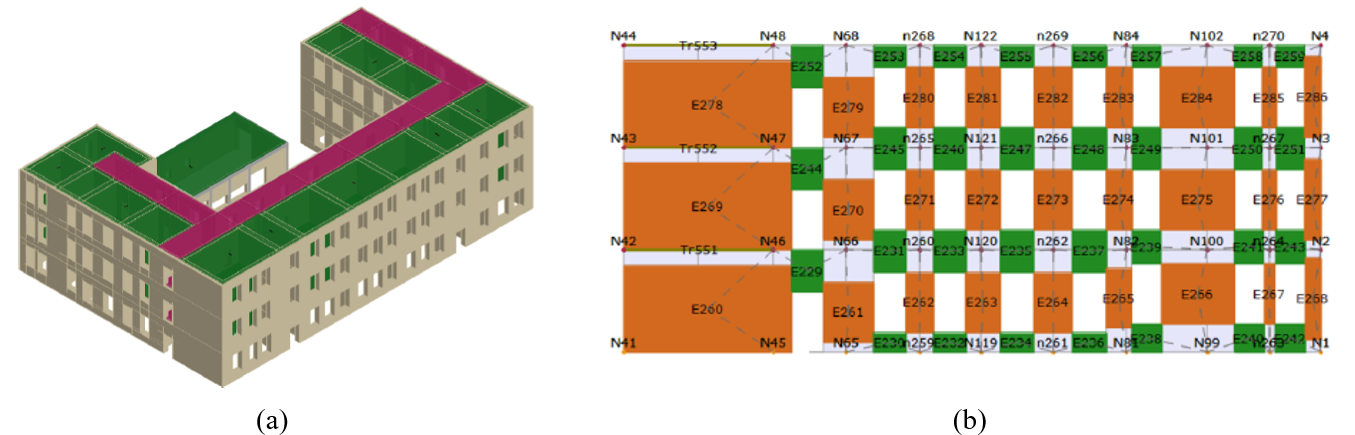
Building 1 consists of masonry units made of tuff stone, which were represented in the structural analysis model as irregular soft-stone masonry (e.g., tuff and calcarenite) under a knowledge level classified as KL1. This designation is associated with a confidence factor of 1.35, which is applied to appropriately reduce the material strength parameters and account for existing uncertainties. The floor system is composed of steel joists combined with hollow clay blocks, resulting in an overall thickness of approximately 25 cm. Within the numerical model, the steel joists were defined using IPE140 sections and were assumed to govern the in-plane deformability of the floors, as rigid diaphragm behavior was not considered.
The applied vertical loading included both the self-weight of the floor system and superimposed non-structural loads, estimated at 3.8 kN/m², in addition to an imposed load of 3 kN/m² corresponding to school occupancy, as specified by Italian design standards. Moreover, the analytical model explicitly accounted for the presence of cross-vault elements in the structure. The structural thickness of these vaults is an average of 15 cm, with a rise of 120 mm and a filling density of 16 kN/m².
In contrast to the preceding case, Building 2 employs a frame system composed of reinforced concrete, augmented by masonry infill walls. The concrete material is designated with a characteristic strength of C20/25, while the reinforcing bars correspond to steel grade B450C. The primary load-bearing components, namely the beams and columns, are designed with rectangular sections measuring 30 by 50 cm. These sections incorporate 16-mm longitudinal reinforcement, accompanied by 8-mm stirrups, which are arranged at a spacing of 15 cm. The floor assemblies are composed of cast-in-place reinforced concrete slabs.
The gravity loading scheme accounts for the dead weight of the slabs in addition to permanent non-structural actions, combined with a variable load of 3 kN/m², consistent with standard requirements for educational facilities.
For the purpose of seismic evaluation, a service life of 50 years was considered, in conjunction with an importance level classified as III, which corresponds to a usage coefficient of 1.5. This coefficient is indicative of the building’s function. Consequently, a seismic reference duration of 75 years was adopted. The ground conditions at the site correspond to a flat topographic profile (category T1) and a soil classification identified as category C, which is representative of medium-compact soils or gravelly formations, in accordance with national seismic regulations.
The structural behavior was assessed through nonlinear static procedures (pushover analysis), incorporating a total of 24 loading scenarios. These scenarios encompassed both principal horizontal axes (X and Y), incorporated the influence of accidental torsional effects, and employed two distinct lateral load patterns: one distributed according to the mass profile and the other derived from the fundamental mode shape of vibration.
Performance of the As-Constructed Model
The seismic behavior of the existing structural model was assessed through a nonlinear incremental analysis procedure, resulting in performance indicators of 0.460 along the X-direction and 0.472 along the Y-direction. These indicators quantify the relationship between the available lateral load-carrying capacity of the system and the seismic action required to satisfy the Life Safety performance criterion in accordance with applicable design regulations.
The comprehensive evaluation reveals that the structure exhibits inadequate capacity to adequately resist earthquake-induced actions, underscoring the imperative for augmenting its resilience. The critical damage patterns corresponding to the most unfavorable loading scenarios in both principal directions are illustrated in Figure 12.
The results of the governing analyses indicate that the majority of the damage is concentrated within the spandrel regions, specifically in the masonry zones situated above and below the openings. The elements in question are predominantly influenced by flexural–compressive plastic mechanisms (illustrated in pink in Figure 12), thereby underscoring their function as the most critical and vulnerable components of the structure. In contrast, the vertical load-bearing piers within the primary walls demonstrate minimal damage, as illustrated in green in Figure 12.
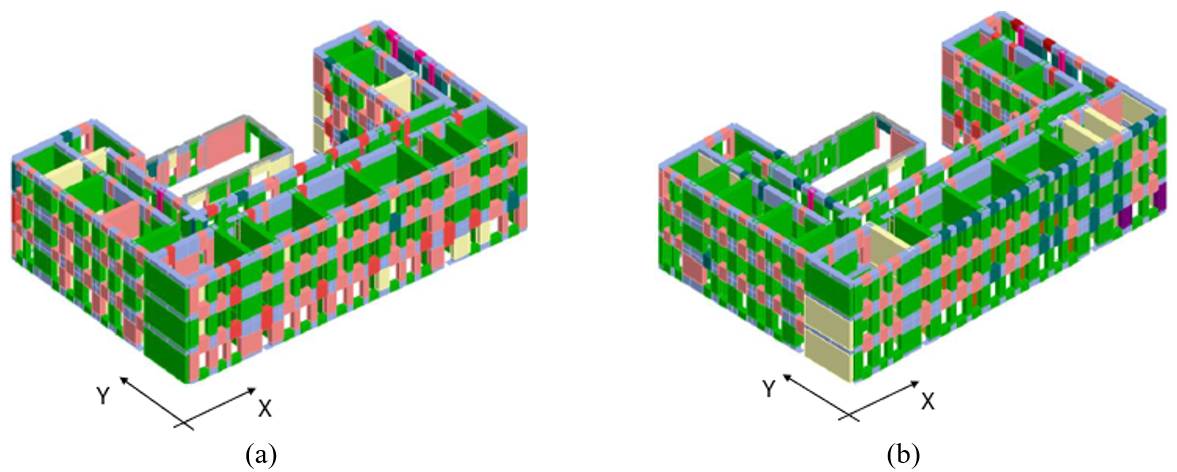
In scenarios of maximal loading in the longitudinal (X) direction, shear-related failures were identified within the masonry (highlighted in yellow), indicating a significant risk of structural degradation. Furthermore, internal cracking associated with tensile stresses (depicted in light blue) was identified in both principal directions (X and Y), thereby further confirming the presence of significant structural deficiencies.
To quantify the overall seismic performance, the structure was classified according to the Italian seismic risk assessment framework (Cosenza et al., 2018). This classification system delineates eight performance categories, ranging from A+ (indicating very low vulnerability) to G (representing severe vulnerability). According to the findings of the global structural evaluation, the edifice was classified as Class D, indicating a moderate to high degree of seismic vulnerability, prior to any retrofitting measures.
Results on the Reinforced Building
The strengthening strategy entailed upgrading the masonry walls through the implementation of a fiber-reinforced plaster system. This layer was based on a sustainable mortar formulation incorporating 4 mm rubber particles at a 5% volumetric replacement and recycled steel fibers at 0.5%, which had previously been identified as the most effective mixture through experimental investigations. In the interest of economic efficiency, the intervention was confined to wall segments that had already been affected by shear-related damage.
In the computational model, the eco-friendly mortar layer was represented as a surface-applied strengthening system attached to the masonry walls, with its mechanical characteristics calibrated based on experimental findings. The material properties attributed to this layer encompass a Young’s modulus of 2187.5 MPa, calculated in relation to the rubber content as documented in (Song et al., 2018), and a tensile capacity of 8 MPa derived from the outcomes of bending tests. The locations of the wall segments that underwent this strengthening approach are illustrated in Figure 13.
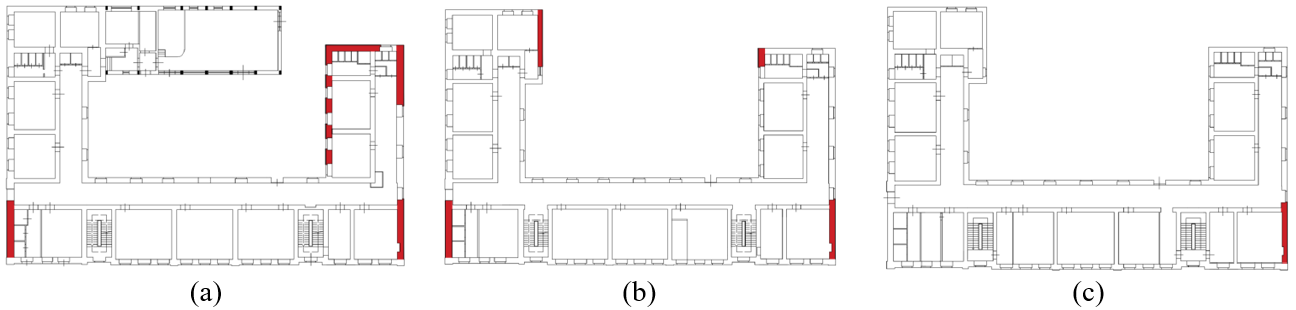
The application of the reinforcement did not affect the dynamic response of the building, as evaluated through a modal analysis. The initial three vibration modes of the structure are outlined in Table 2.
Table 2. Modal Analysis Results.
| Mode | T [s] | Mx [%] | My [%] | Mz [%] |
|---|---|---|---|---|
| 1 | 0.44 | 17.5 | 31.7 | 0.02 |
| 2 | 0.42 | 40.1 | 35.5 | 0.01 |
| 3 | 0.39 | 18.7 | 3.5 | 0.00 |
The evaluation of the strengthened configuration yielded performance values of 0.635 along the X-axis and 0.613 along the Y-axis, corresponding to increases of 0.175 and 0.141 compared to the initial condition. The findings indicate that the enhanced system meets the seismic performance criteria stipulated by Italian regulations in both principal directions.
For buildings categorized under importance class III, such provisions necessitate a minimum increment of 0.1 in the performance indicator and a target value not lower than 0.6. The implementation of a targeted strengthening strategy resulted in a reevaluation of the structure’s seismic risk classification, with a subsequent shift from category D to category C following the intervention.
Conclusion
This study investigated the viability of incorporating recycled constituents, specifically rubber particles and steel fibers derived from end-of-life tires, into the development of a sustainable mortar intended for seismic strengthening applications. The investigative process was meticulously structured into three distinct phases: the experimental characterization of materials, the optimization of mixture proportions, and the validation of the methodology through its application to a tangible structural case study.
A series of laboratory experiments were conducted to assess the physical and mechanical behavior of mortar mixtures prepared with varying contents of rubber and fiber inclusions. The final formulation, which incorporated 5% 4 mm rubber particles and 0.5% recycled steel fibers, exhibited an overall balanced response. Specifically, it exhibited an enhancement of approximately 11% in flexural capacity, accompanied by a comparatively modest decline of about 8% in compressive strength when compared to a conventional mortar.
Subsequently, the selected mix was used for the retrofitting of the “G. Mazza” masonry school building in Torre del Greco, an area susceptible to high seismic activity. A numerical model of the building, both in its original and reinforced states, was constructed using the 3Muri software.
Subsequent to the implementation of the strengthening intervention, the seismic performance indices increased from 0.460 and 0.472 to 0.635 and 0.613 in the longitudinal (X) and transverse (Y) directions, respectively. These enhancements satisfy the seismic performance criteria specified by Italian regulations for educational facilities and result in an upgrade of the building’s seismic risk classification from class D to class C. The findings demonstrate the effectiveness of incorporating recycled constituents in producing sustainable materials that simultaneously enhance structural behavior under seismic loading. The valorization of waste-derived resources for earthquake-resistant applications supports circular economy strategies while providing tangible improvements in structural resilience.
Subsequent investigations could augment these findings by assessing analogous material systems in varied structural configurations, thus facilitating the broader implementation of sustainable solutions in both new construction and rehabilitation practices.
Declarations
Authors’ Contributions
E.M: Software, Formal analysis, Investigation, Data curation, Writing of the original draft.
A.F: Conceptualization, Methodology, Validation, Resources, Writing – review & editing, Visualization, Supervision, Funding acquisition.
Conflict of Interest
The authors declare that they have no known competing financial interests or personal relationships that could have appeared to influence the work reported in this paper.
Funding
This research did not receive any specific grant from funding agencies in the public, commercial, or not-for-profit sectors.
Declaration on the Use of Generative AI and AI-Assisted Technologies
No generative AI or AI-assisted technologies were used in the preparation of this manuscript.
Data Availability
The data that support the findings of this study are available from the corresponding author upon reasonable request.
Acknowledgement
The authors would like to thank Nicoletta Napolitano for her valuable contribution to the experimental work and numerical analyses performed during her Master’s thesis.
Ethics
This study did not involve human participants or animals; hence, no ethical approval was required.
References
- Abdolpour, H., Niewiadomski, P., Sadowski, Ł., & Kwiecień, A. (2022). Engineering of ultra-high performance self-compacting mortar with recycled steel fibres extracted from waste tires. Archives of Civil and Mechanical Engineering, 22(4), 175. https://doi.org/10.1007/s43452-022-00496-4
- Aiello, M. A., Leuzzi, F., Centonze, G., & Maffezzoli, A. (2009). Use of steel fibres recovered from waste tyres as reinforcement in concrete: Pull-out behaviour, compressive and flexural strength. Waste Management, 29(6), 1960–1970. https://doi.org/10.1016/j.wasman.2008.12.002
- Awolusi, T. F., Oke, O. L., Akinkurolere, O. O., & Sojobi, A. O. (2019). Application of response surface methodology: Predicting and optimizing the properties of concrete containing steel fibre extracted from waste tires with limestone powder as filler. Case Studies in Construction Materials, 10, e00212. https://doi.org/10.1016/j.cscm.2018.e00212
- Bravo, M., & de Brito, J. (2012). Concrete made with used tyre aggregate: durability-related performance. Journal of Cleaner Production, 25, 42–50. https://doi.org/10.1016/j.jclepro.2011.11.066
- Buruzs, A., & Kozma, K. (2023). The Realization of a Circular Economy in the Construction Industry and Its Adaptation to EU Standards in Hungary. Chemical Engineering Transactions, 107, 535–540. https://doi.org/10.3303/CET23107090
- Bušić, R., Miličević, I., Šipoš, T. K., & Strukar, K. (2018). Recycled Rubber as an Aggregate Replacement in Self-Compacting Concrete—Literature Overview. Materials, 11(9), 1729. https://doi.org/10.3390/ma11091729
- Centonze, G., Leone, M., & Aiello, M. A. (2012). Steel fibers from waste tires as reinforcement in concrete: A mechanical characterization. Construction and Building Materials, 36, 46–57. https://doi.org/10.1016/j.conbuildmat.2012.04.088
- Cosenza, E., Del Vecchio, C., Di Ludovico, M., Dolce, M., Moroni, C., Prota, A., & Renzi, E. (2018). The Italian guidelines for seismic risk classification of constructions: technical principles and validation. Bulletin of Earthquake Engineering, 16(12), 5905–5935. https://doi.org/10.1007/s10518-018-0431-8
- EN 196-1. (2019). Methods of testing cement – Part 1: Determination of strength.
- EN 1015-6. (1999). Methods of test for mortar for masonry – Part 6: Determination of bulk density of fresh mortar.
- Formisano, A., Mazzolani, F. M., & Indirli, M. (2024). L’edificio scolastico “G. Mazza” in Torre del Greco (NA): analisi del comportamento sismico e progetto di adeguamento. ID-241. https://www.iris.unina.it/handle/11588/399642
- Kilani, A. J., Ikotun, B. D., & Abdulwahab, R. (2024). Effect of Crumb Rubber on Concrete’s and Mortar’s Structural Properties: A Review. Iranian Journal of Science and Technology, Transactions of Civil Engineering. https://doi.org/10.1007/s40996-024-01647-8
- Marinelli, S., Marinello, S., Lolli, F., Gamberini, R., & Coruzzolo, A. M. (2023). Waste Plastic and Rubber in Concrete and Cement Mortar: A Tertiary Literature Review. Sustainability, 15(9), 7232. https://doi.org/10.3390/su15097232
- Michalik, A., Chyliński, F., Piekarczuk, A., & Pichór, W. (2023). Evaluation of recycled tyre steel fibres adhesion to cement matrix. Journal of Building Engineering, 68, 106146. https://doi.org/10.1016/j.jobe.2023.106146
- Papamichael, I., Voukkali, I., Loizia, P., & Zorpas, A. A. (2023). Construction and demolition waste framework of circular economy: A mini review. Waste Management & Research, 41(12), 1728–1740. https://doi.org/10.1177/0734242X231190804
- Pilakoutas, K., Neocleous, K., & Tlemat, H. (2004). Reuse of tyre steel fibres as concrete reinforcement. Proceedings of the Institution of Civil Engineers – Engineering Sustainability, 157(3), 131–138. https://doi.org/10.1680/ensu.2004.157.3.131
- Prieto-Sandoval, V., Jaca, C., & Ormazabal, M. (2017). Economía circular: Relación con la evolución del concepto de sostenibilidad y estrategias para su implementación. Memoria Investigaciones En Ingeniería, 15.
- Purchase, C. K., Al Zulayq, D. M., O’Brien, B. T., Kowalewski, M. J., Berenjian, A., Tarighaleslami, A. H., & Seifan, M. (2021). Circular Economy of Construction and Demolition Waste: A Literature Review on Lessons, Challenges, and Benefits. Materials, 15(1), 76. https://doi.org/10.3390/ma15010076
- Son, K. S., Hajirasouliha, I., & Pilakoutas, K. (2011). Strength and deformability of waste tyre rubber-filled reinforced concrete columns. Construction and Building Materials, 25(1), 218–226. https://doi.org/10.1016/j.conbuildmat.2010.06.035
- Song, W.-J., Qiao, W.-G., Yang, X.-X., Lin, D.-G., & Li, Y.-Z. (2018). Mechanical properties and constitutive equations of crumb rubber mortars. Construction and Building Materials, 172, 660–669. https://doi.org/10.1016/j.conbuildmat.2018.03.263
- Tang, Y., Feng, W., Chen, Z., Nong, Y., Yao, M., & Liu, J. (2021). Experimental and Theoretical Investigation on the Thermo-Mechanical Properties of Recycled Aggregate Concrete Containing Recycled Rubber. Frontiers in Materials, 8. https://doi.org/10.3389/fmats.2021.655097
- Youssf, O., ElGawady, M. A., & Mills, J. E. (2016). Static cyclic behaviour of FRP-confined crumb rubber concrete columns. Engineering Structures, 113, 371–387. https://doi.org/10.1016/j.engstruct.2016.01.033
- Youssf, O., Mills, J. E., & Hassanli, R. (2016). Assessment of the mechanical performance of crumb rubber concrete. Construction and Building Materials, 125, 175–183. https://doi.org/10.1016/j.conbuildmat.2016.08.040
- Zia, A., Pu, Z., Holly, I., Umar, T., Tariq, M. A. U. R., & Sufian, M. (2022). A Comprehensive Review of Incorporating Steel Fibers of Waste Tires in Cement Composites and Its Applications. Materials, 15(21), 7420. https://doi.org/10.3390/ma15217420
- Zvirgzdins, J., Plotka, K., & Geipele, S. (2019, December 3). Circular economy in built environment and real estate industry. Modern Building Materials, Structures and Techniques. https://doi.org/10.3846/mbmst.2019.046
Copyright © 2026 by the authors. Licensee Scientific Steps International Publishing Services, Dubai, UAE.
This article is an open access article distributed under the terms and conditions of the
Creative Commons Attribution (CC BY) 4.0 license.